EVENT: Geopolitical Risks and the Future of Multilateral Order
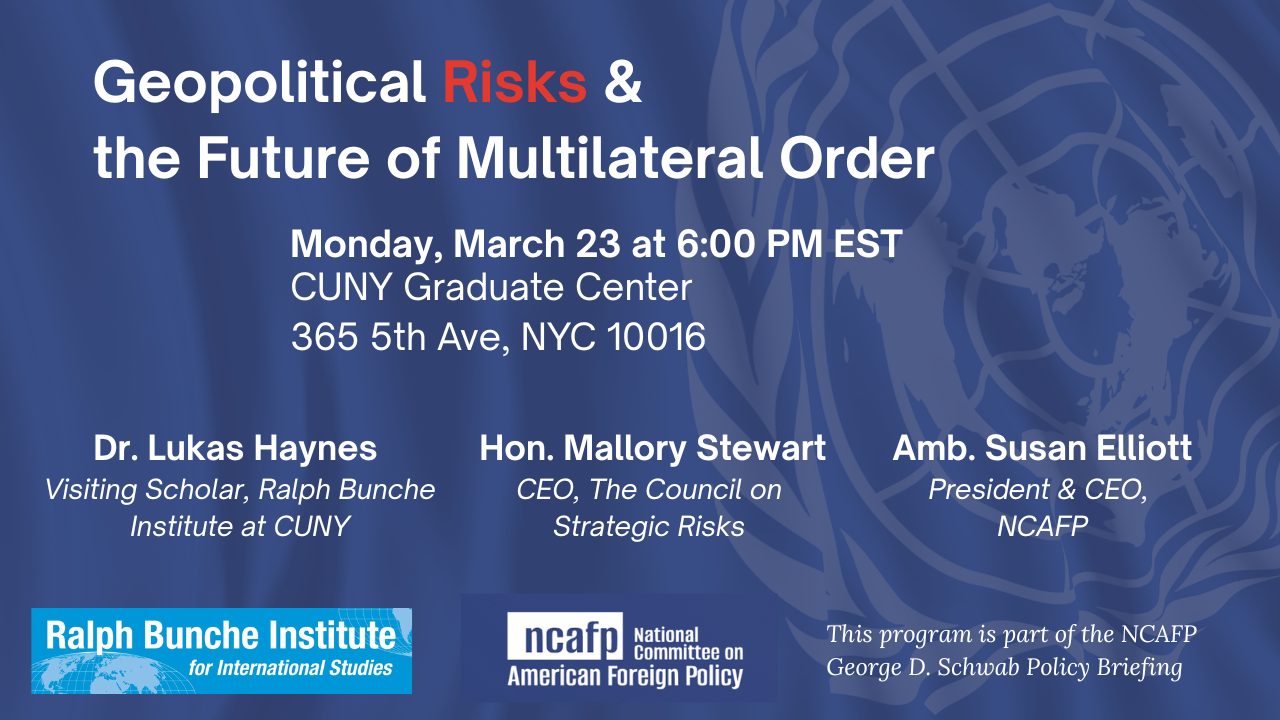
Geopolitical Risks and the Future of Multilateral Order
with Lukas Haynes and Mallory Stewart
Monday, March 23, 2026
Moderated by Susan Elliott
In partnership with the Ralph Bunche Institute for International Studies, Geopolitical Risks and the Future of Multilateral Order explores how rising global tensions and shifting norms are reshaping the United States security cooperation.
Monday, March 23, 2026
Skylight Room, CUNY Graduate Center
365 5th Ave, NYC 10016
Doors Open at 5:45 PM
Program: 6:00 PM – 7:00 PM
Reception: 7:00 PM – 8:00 PM
As the U.S. navigates a new era of great-power competition, abrupt regional conflicts, economic fragmentation, and technological disruption, our national security apparatus and long-trusted multilateral institutions are facing mounting strains. The speed and complexity of these global crises have challenged traditional policy decision-making and the long-established rules-based order.
How can we evaluate the effectiveness and future-proof multilateral institutions and alliances, such as the United Nations Peacekeeping operations, the World Trade Organization, and NATO? What are the current drivers, risks, and challenges in various geopolitical theaters that are disrupting the Order? And what can history teach us about analyzing risk and working towards pragmatic outcomes in U.S. diplomacy and international cooperation?
Please join the Honorable Mallory Stewart, CEO of The Council on Strategic Risks and former Assistant Secretary for the Bureau of Arms Control, Deterrence, and Stability at the U.S. Department of State; Dr. Lukas Haynes, visiting scholar at the Ralph Bunche Institute for International Studies and former Policy Planning Staff of the U.S. Department of State, as they discuss the origins and obstacles of foreign policy frameworks. This conversation will be moderated by Ambassador Susan Elliott, President and CEO, NCAFP.
This program is part of the NCAFP’s George D. Schwab Policy Briefings.
Featured Speakers:
The Honorable Mallory Stewart is the Chief Executive Officer of The Council on Strategic Risks, a nonprofit, non-partisan, security policy institute in Washington, DC. Her areas of expertise include weapons of mass destruction and outer space law and policy, and risk management regarding strategic stability and emerging and disruptive technologies. From 2022 to 2025, she served as the Assistant Secretary for the Bureau of Arms Control, Deterrence, and Stability in the U.S. Department of State. She joined the bureau after serving as the Senior Director for Arms Control, Disarmament, and Nonproliferation at the National Security Council from January 2021. From 2015 to 2017, Ms. Stewart was Deputy Assistant Secretary of State for Emerging Security Challenges and Defense Policy in what was then called the Bureau of Arms Control, Verification and Compliance. Before her time in the Arms Control Bureau, Ms. Stewart served as an attorney adviser in the Department of State’s Office of the Legal Adviser. She joined the Legal Adviser’s Office in 2002, and in that role she worked on numerous legal issues related to nonproliferation, arms control, deterrence, and U.S. participation in international treaties. Ms. Stewart holds an A.B. from Harvard College and a J.D. from Stanford Law School.
Dr. Lukas Haynes is a visiting scholar at the Ralph Bunche Institute for International Studies at the CUNY Graduate Center. His research examines the intersection of philanthropic, political, and mission-related investments to protect democratic institutions and national security. For two decades in philanthropy, Haynes shaped strategies at the David Rockefeller Fund, the John D. and Catherine T. MacArthur Foundation, and the Mertz Gilmore Foundation to advance national security, democracy protection, and climate change mitigation.
Haynes is the recent author of Peace Through Power: FDR’s Military Leaders and the Pragmatism of the UN Charter (Foreign Policy Association, 2025), which analyzes how U.S. military leaders sought to preserve Great Power peace by shaping the UN Charter’s provisions on collective security, the use of force and the veto.
From 2000-01, Haynes served on the Policy Planning Staff of the U.S. Department of State as a speechwriter for Secretary of State Madeleine Albright. Haynes has been a visiting Fellow at Stanford’s Center on Philanthropy and Civil Society and a Harvard University Kennedy School Fellow. He is a life member of the Council on Foreign Relations since 2000 and serves on the Advisory Board of the Center for Climate and Security.
Ambassador (ret.) Susan M. Elliott is the President and CEO of the National Committee on American Foreign Policy. She is also an accomplished diplomat, having served for 27 years in a variety of leadership positions at the U.S. Department of State.
Ambassador Elliott was the U.S. Ambassador to Tajikistan from 2012 to 2015. Prior to her appointment, she served as the Deputy Assistant Secretary of State, Bureau of South and Central Asian Affairs. Her previous overseas assignments include Minister Counselor for Political Affairs in Moscow; Principal Officer in Belfast, Northern Ireland; Deputy Economic Counselor and Visa Section Chief in Athens, Greece. Among many other assignments. Prior to leaving the State Department, Ambassador Elliott served as the Civilian Deputy and Foreign Policy Advisor to the Commander of the United States European Command. She also holds a PhD from Indiana University.