EVENT RECAP: Forum on Asia Pacific-Security’s Track II Dialogues
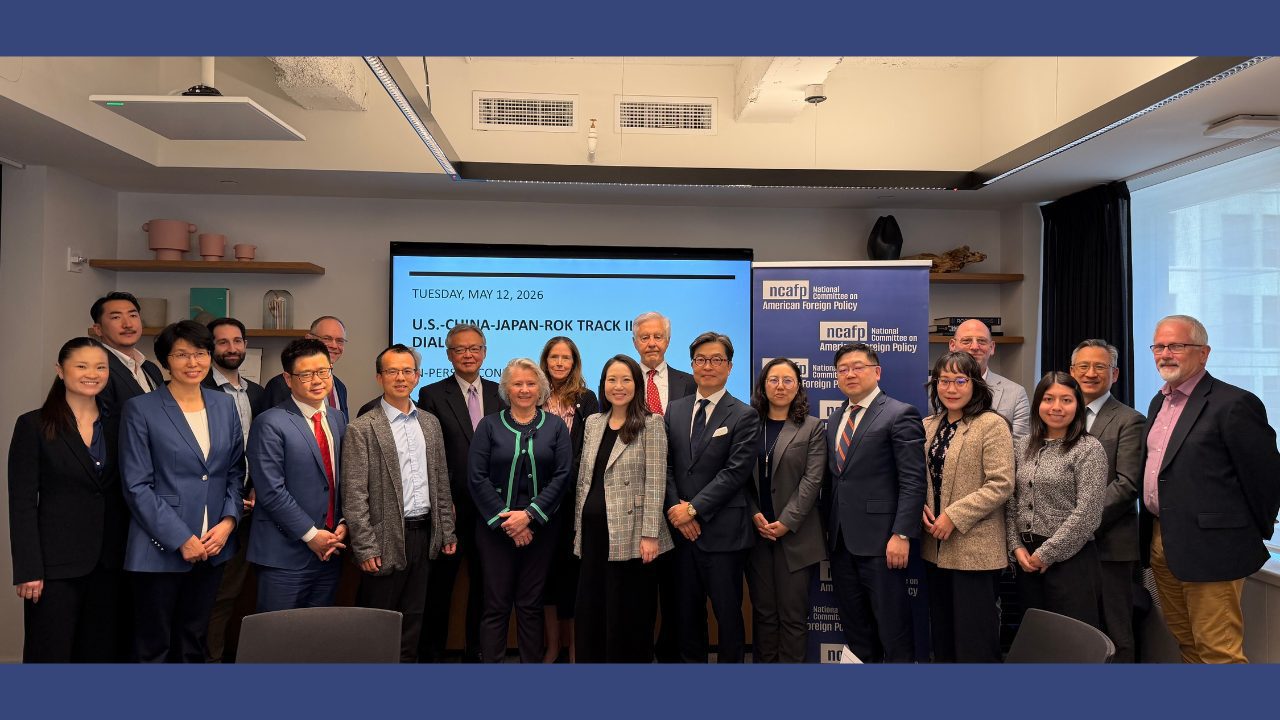
Forum on Asia Pacific-Security’s Track II Dialogues
May 10-12, 2026
Moderated by Susan A. Thornton
The National Committee on American Foreign Policy (NCAFP) convened a series of high-level Track II discussions in early May 2026. The three separate conferences, which included participants from the United States, China, Japan, and the Republic of Korea, were held under the Chatham House Rule. These participants included prominent former officials, experts, and scholars from the region and across the U.S.
During the U.S.-China Bilateral Dialogue, participants from the U.S. and China addressed perceived challenges and aired common concerns regarding their leader-to-leader relationship and the upcoming summits. They also discussed regional security and conflict prevention, economic negotiations and fragmentation, the creation of frameworks for global AI governance, and the surfacing tensions between their respective alliances throughout the region and around the Middle East.
The U.S.-China-Japan-Republic of Korea Track II followed on day two. As the United States administration recalibrates many of its key alliances, the delegations expressed their shared concerns about how to manage perceived security threats. During the conference, other themes were examined, such as identifying drivers and top priorities in the domestic and international political economy, exploring pathways to re-engage North Korea on nuclear deterrence, and the prospects for greater stability with multilateral and minilateral orders. Participants concluded by stating policy recommendations to ease regional tensions and to prevent miscalculations.
The conference concluded with the U.S.-Japan-Republic of Korea Track II. The three sides discussed the importance of continuing to work on their alliances and strengthening regional security cooperation. In the midst of growing global tensions and unpredictability in U.S.-China relations, constructive policy recommendations were made to cover the short-term and long-term diplomatic maneuvers with a nuclear-armed North Korea and derisking economic interdependence with the United States.
A comprehensive report of the discussions and policy recommendations will be available soon.