EVENT RECAP: Ukraine: Moving Towards Peace?

Ukraine: Moving Towards Peace? with Amb. Melnyk and Amb. Popadiuk
October 15, 2025
with Andrii Melnyk and Roman Popadiuk
Moderated by Susan Elliott
Written by William Robbins
In partnership with the Ralph Bunche Institute for International Studies at the City University of New York (CUNY), the National Committee on American Foreign Policy hosted an invitation-only program about the ongoing war in Ukraine and its impact on regional and global security. This conversation featured Ambassador Andrii Melnyk, Permanent Representative of the Ukraine Mission to the United Nations, Ambassador (ret.) Roman Popadiuk, former and first U.S. Ambassador to Ukraine, and Ambassador (ret.) Susan M. Elliott, President and CEO of the NCAFP, who also moderated the discussion
After almost four years since Russia’s full-scale invasion of the country, Ukraine’s resistance remains as a defining factor in greater European stability. Ambassador Melnyk noted that the evolving relationship between Kyiv and Washington reflects a new “atmosphere of trust” and encouraged further engagement to support a long-term partnership. The conversation also addressed U.S. weapons packages to Ukraine, namely, the potential transfer of Tomahawk cruise missiles. Ambassador Popadiuk explained that providing Ukraine with long-range weapons could force the Russians to “consider their position.” Tomahawk missiles would grant Ukraine the ability to strike critical infrastructure deep within Russian territory, especially oil and gas refineries that are driving its current war-time economy. Nonetheless, concerns regarding equipment availability and delivery remain.
Ambassador Melnyk reflected that Ukraine relies on united military, economic, and diplomatic pressure to achieve peacebuilding initiatives. He also stated the importance of implementing secondary sanctions. Such sanctions would be imposed on nations that indirectly finance Russia’s war offensive through energy imports. Both featured speakers noted that transatlantic alignment is essential to effective restrictions while signaling a unified front. Ambassador Popadiuk reiterated that consistent, forward-focused U.S. support remains vital for Ukrainian deterrence. However, he cautioned against implementing restrictions on Ukraine’s usage of weapons systems, as not to limit strategic flexibility or to provide Moscow with advanced warning as negotiation efforts are ongoing.
Both Ambassadors agree that a Ukrainian recovery cannot be postponed until the end of war fighting. Reconstruction efforts, which are now estimated to be in excess of $524 billion, will require coordination between governments, multilateral institutions, and the private sector. They stressed that the human aspects of reconstruction (safe returns, education, community rebuilding) will heavily influence the success of any future peace agreement.
The discussion examined how Russia’s domestic political climate and closed information systems support the endurance of the Russian war effort. Ambassador Popadiuk added that a stalemate situation would depend on battlefield conditions or could evolve if internal change within Russia alters its course.
Ambassador Elliott provided the concluding remarks and stated that, although we are witnessing early efforts by the Trump Administration to negotiate a ceasefire, both the Russians and the Ukrainians are proud nations and would need to make difficult compromises — either in territory or in security guarantees —to find a resolution.
Questions taken from the audience ranged from hybrid and information-warfare, the recent airspace violations from Russia, and the dedication of nonprofits helping with displacement and refugee resettlements. A light reception followed the program, and audience members continued with informal conversations with the distinguished panel.

Dr. Eli Karetny, Director of The Ralph Bunche Institute, introducing the program.
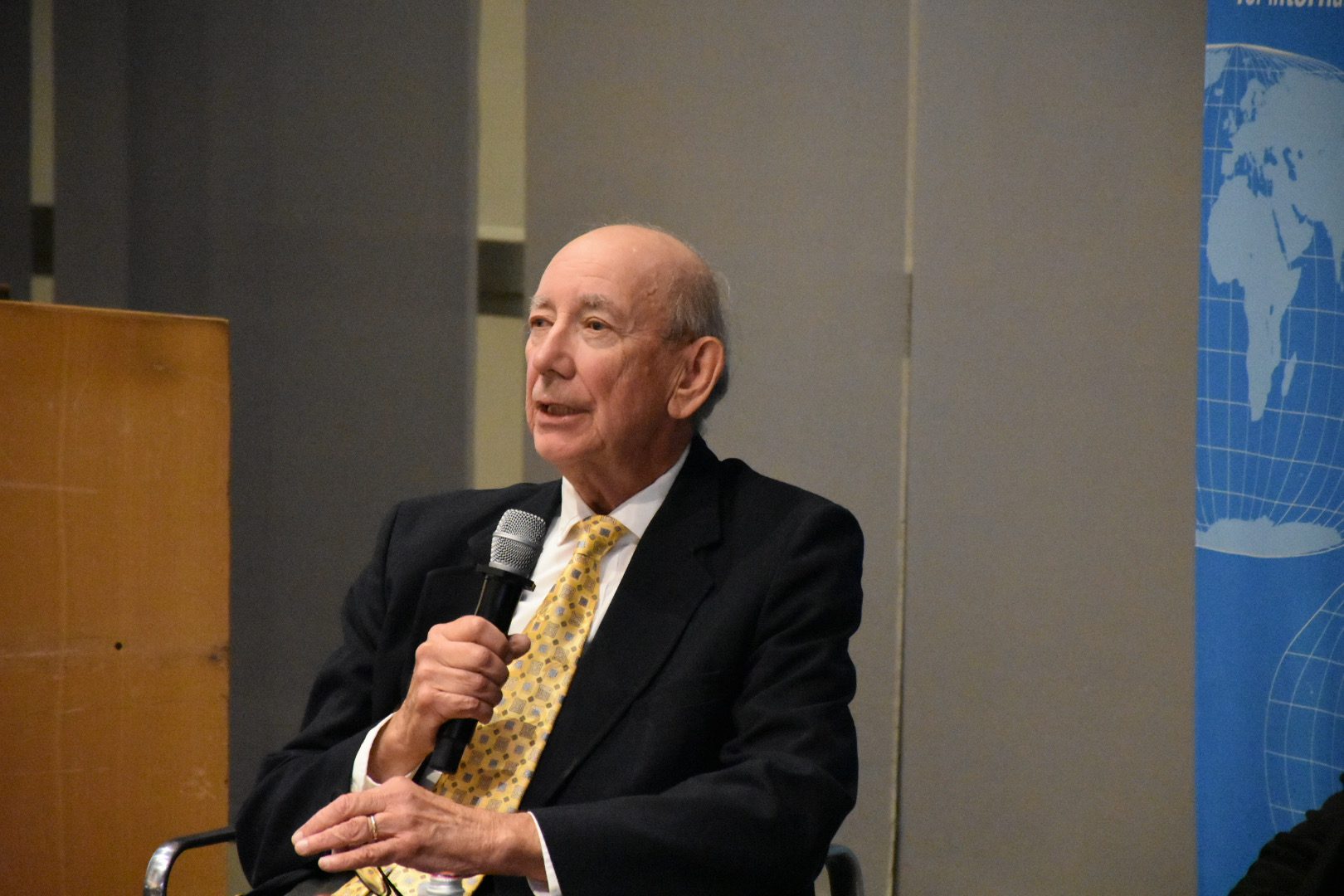
Amb. Roman Popadiuk providing analysis on the Ukraine War.

Amb. Andrii Melnyk answering a question from the moderator, Amb. Susan Elliott.
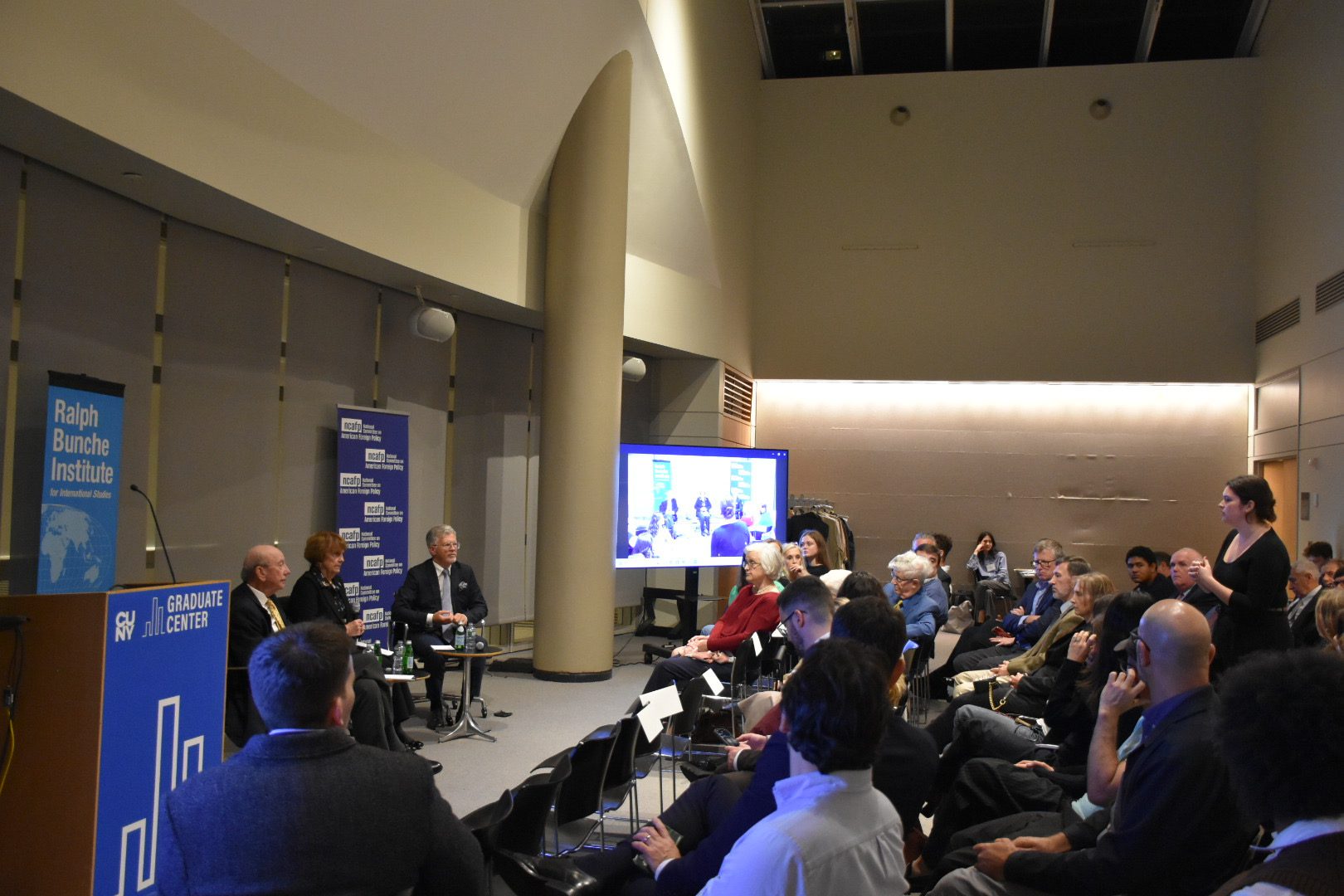
Audience member asking a question to the panel.

Amb. Popadiuk speaking with students.
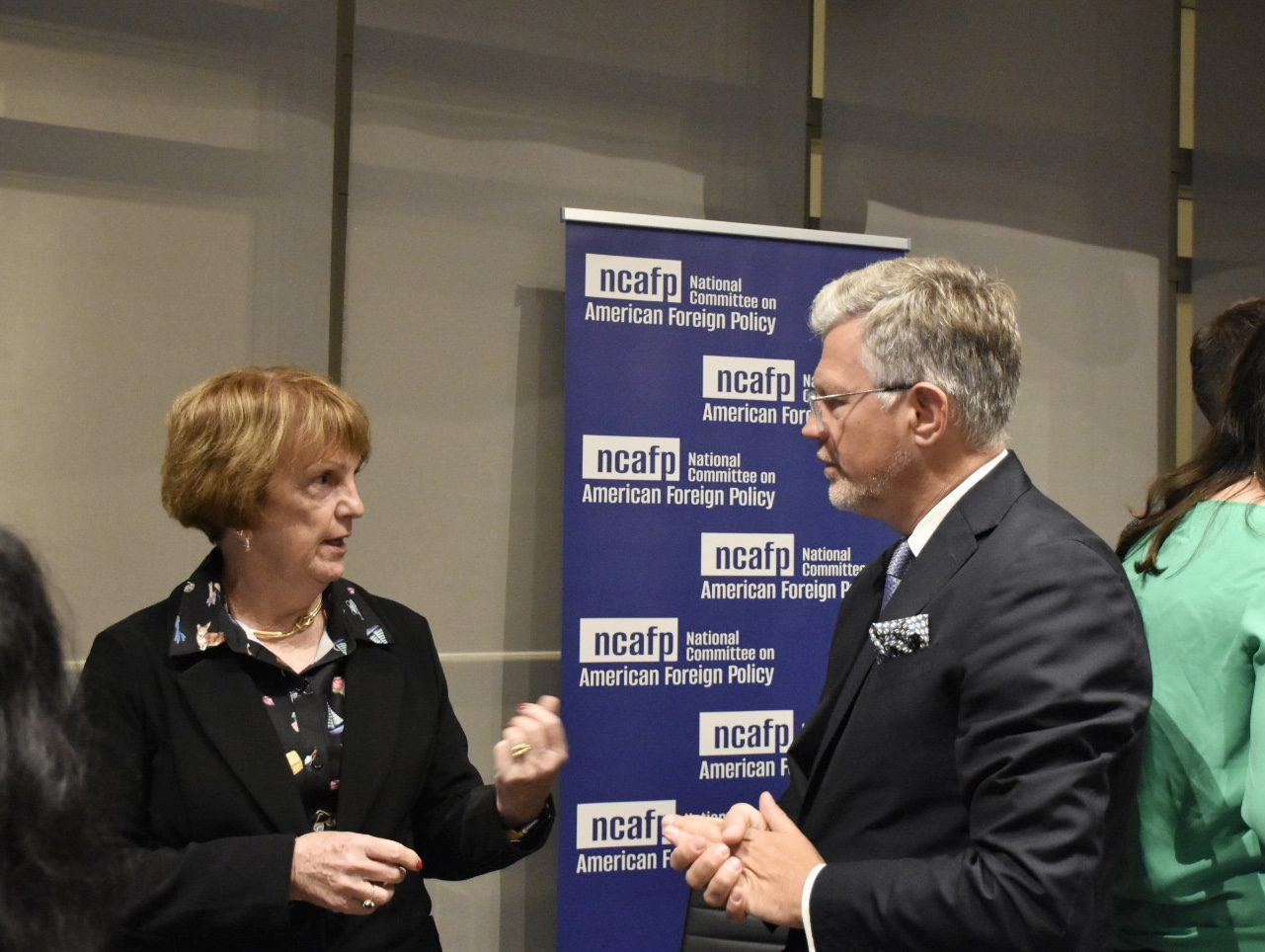
Amb. Elliott and Amb. Melnyk converse after during the reception.
Featured Speakers
Ambassador (ret.) Roman Popadiuk (Ph.D. ’81, Political Science), Former United States Ambassador to Ukraine, President of the Diplomacy Center Foundation, Diplomat in Residence at the Ralph Bunche Institute.
Roman Popadiuk is a retired member of the Senior Foreign Service. Born in a displaced persons camp in Austria following World War II to Ukrainian parents, he rose to serve as the first U.S. ambassador to Ukraine from 1992 to 1993. Prior to that, he served as deputy assistant to the president and deputy press secretary for foreign affairs under President George H.W. Bush, positions he also held toward the end of President Ronald Reagan’s administration. From 1999 to 2012, he was the executive director of the George Bush Presidential Library Foundation at Texas A&M University. He is a member of the Council on Foreign Relations and the Hunter College Hall of Fame.
Ambassador Andrii Melnyk is the Permanent Representative of Ukraine to the United Nations, and is a senior member of the Ukrainian foreign service. Previously, Ambassador Melnyk served as the Ambassador of Ukraine to Brazil (2023–2025), Deputy Minister of Foreign Affairs of Ukraine (2022–2023), and as the Ambassador of Ukraine to the Federal Republic of Germany. He has held a Director General post in Ukraine’s Ministry of Foreign Affairs (2010–2014), which saw him stationed in Austria and Germany. In this capacity, he worked closely on Ukraine’s security cooperation initiatives and European integration strategy.
Ambassador Melnyk holds a PhD in International and Comparative Law from the National Academy of Sciences of Ukraine and joined Ukraine’s National Security Program at Harvard University’s John F. Kennedy School of Government. He is the author of numerous publications in the field of international public law, and has been the recipient of Ukraine’s first-class, second-class, and third-class Order of Merit awards.
Ambassador (ret.) Susan M. Elliott is the President and CEO of the National Committee on American Foreign Policy. She is also an accomplished diplomat, having served for 27 years in a variety of leadership positions at the U.S. Department of State.
Ambassador Elliott was the U.S. Ambassador to Tajikistan from 2012 to 2015. Prior to her appointment, she served as the Deputy Assistant Secretary of State, Bureau of South and Central Asian Affairs. Her previous overseas assignments include Minister Counselor for Political Affairs in Moscow; Principal Officer in Belfast, Northern Ireland; Deputy Economic Counselor and Visa Section Chief in Athens, Greece. Among many other assignments.
Prior to leaving the State Department, Ambassador Elliott served as the Civilian Deputy and Foreign Policy Advisor to the Commander of the United States European Command. She also holds a PhD from Indiana University.
Mr. William Robbins is the Fall 2025 NCAFP Policy Intern. He is currently a student of Chinese Studies and Linguistics at Fordham University.